Discover a marvellous trip back to Lancaster of the past by author Bill Jervis, which we plan to release in weekly segments. Although the story is set in Lancaster the family and most of the characters within are entirely fictitious -- but this story does chart a way of life largely lost and which many Lancastrians may recall with equal horror and affection...
Showing posts with label Dalton Square. Show all posts

Monday, 5 December 2011

Chapter Ten: Pranks

Clog Irons
Pranks

Michael's and Rob's mothers became friends. Mrs Matthews would leave Rob at Michael's while she went shopping. Sometimes, Rob's mother would stay at Michael's and look after the four children, while Michael's mother went up-town.

Michael knew all about Robin Hood and King Arthur and the boys played pretend games and acted the stories. Michael had some lead soldiers which his Dad's mate at work had made for him. Only one soldier was in a coloured uniform. The others were just plain lead.

"Don't suck them! They're poisonous!" warned Michael, repeating what his Dad had told him.

When it was Michael's turn to have the painted one, he imagined it was his heroic Grandad Eli, the one he had never known, the one who had been killed in the war, in 1915. One day,  Rob said, "There's going to be another war."

Michael responded with, "Who says so?"

"My dad. He says if we don't listen to Churchill, we'll be in big trouble."

"Who's Churchill?

"I don't know. I haven't asked him."

Another time, the two boys were playing out the front and a passing neighbour, Celia Wilkinson, gave them a bobbin with thread on it. Michael knew her friendly face well. She was one of the workers who waved to him when he was watching them all go to the mill on Moor Lane.

She'd nicked it from work, and Michael said, "Coo, it's got miles on it. Let's tie up the houses." So they did.

It was quiet in the street, a mild, spring afternoon, and nobody about. They tied the end of the thread to Michael's front-door knocker and unravelled it carefully down the side alley. They turned left down the back alley, under the shadow of the throbbing mill, and went back into Edward Street from the far-side, near the little shop, which was closed for the afternoon.

Finally, they made their way back up the street, keeping the thread taut across windowsills and across doorways as they went.

They did not snap the thread once. Their mission was completed back at Michael's again. Then they both laughed. They were always laughing. They just saw the funny side of things in the same sort of way.

Another time, Michael said, "Let's go and see my Nan."

"Where does she live?"

"Not far, I know the way," said Michael. "We'll go on our scooters."

"What will our Mams say?"

"Don't worry! It'll be worth it. My Nan always gives me some sweets."

"All right then."

It was a bit steep up Friar Street so they had to stop scooting and pushed their scooters up the slope. They stopped to peep in at the shire horses, which were kept on the left hand side, just across Moor Lane from Mitchell's, in Brewery Lane. The strong horses were used to pull heavy loads all round the town.

Some of the horses were in the shed which acted as their stable. One huge horse was tethered to a post in the middle of the yard. The boys peered at the animals through the spaces between the bars of the wide, high, iron gates.

"See that white one," said Michael, "My Nan's neighbour, Mrs. Wilson, used to own her, when she lived on a canal boat. It's called Florrie and she used to pull a barge."

"Big, aren't they?" said Rob.

"Yes, and they can hurt you," replied Michael. "Mam says I should never try to touch them or stroke them."

"That's all right," said Rob, "I don't want to really anyway do you?"

"No," said Michael, as one of the huge beasts stamped a heavy hoof. The ground shook beneath their feet and the gate they were leaning on rattled. That horse was a real giant.

On an impulse, Michael bent down and picked up a small stone. He threw it at the big horse but missed. It turned its head slowly towards them, more in curiosity than alarm Just then, by coincidence, a man emerged from the shed.

Michael thought he might have seen him throw the pebble. His heart stood still. His stomach turned over.

"Run!" he shouted at Rob. "He's after us!"

The man was only fiddling with the horse's tether but Rob needed no urging. The pair of them hurtled up the hill, dragging their scooters behind them.

There was a perverse pleasure in feeling they were being chased and escaping their pursuer. They liked having adventures together.

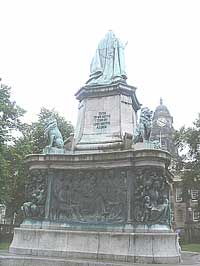
They crossed Dalton Square. In the middle of the square they took turns to climb up onto the few-inches-wide edge of the plinth, which supported Queen Victoria's statue. They both managed to go all the way round, rubbing noses on the way with the carvings of eminent Victorians, before they climbed down again to safety. Michael didn't tell Rob that was the first time he'd done it, without his mother helping and waiting to catch him, if he slipped.

They managed to cross the main road without any problems because there was hardly any traffic, even though it was one of the main roads, north and south, through Lancaster.

They passed the end of George Street. They paused and watched a clogger in a leather apron working near the window of the clog repairers in Thurnham Street. The man smiled at them and went on fitting strips of iron to the wooden sole of a clog. The boys turned into Marton Street. Nan's was at the near end and she was really pleased to see them.

She gave them some sweets from the tin which she kept in a cupboard. They sat quietly next to each other on her settee while Nan went on with what she'd been doing.

They watched her take some bread out of the oven at the side of the fire. She turned her bread tins upside down on the well-scrubbed, wooden table and lifted them. Under each one was a fresh loaf.

"Done to a turn. Risen nicely they have!" Nan declared, wiping her hands on her apron, after inspecting her baking for flaws. The aroma from the bread made the boys' nostrils twitch. It smelt lovely. They had an unexpected bonus, when she laid some butter on thickly and gave each of them a bit of the crust off one of her still-hot loaves.

"Just a taster each," said Nan. "Tha mustn't spoil tha teas or I'll have your mothers after me."

They still sat close together on her settee contentedly, eating the bread, sucking the sweets, swinging their legs, talking to Nan.

Then Michael's and Rob's mothers arrived, both frantic, after searching all over the place for the two boys. There was a terrible row. Margaret blamed Nan for the boys' going missing.

"I didn't know they were coming. It's nothing to do with me," Nan protested. "I thought you'd let them come."

"Course I didn't! Would I do that, with that main road to cross?"

"Well it did cross my mind that it was a bit funny but you young ‘uns are always doing funny things."

That did it: they had a real set to.

Michael was smugly pleased. Any anger at what they'd done was turned away from him and he felt satisfied that he was the cause of the commotion. Nan was secretly happy because her grandson had had the urge to come and see her. And she really enjoyed having a go at the silly young thing who had married her Gordon. It was about time that she was put in her place, brought down a peg or two.

Only Margaret lost out, especially as she'd had to beg Next-door to keep an eye on the babies' prams in the yard, while she and Sheila Matthews went looking for the missing boys. Only that morning she had vowed to herself that she wouldn't talk to her unfriendly neighbour again, after further complaints, this time about Margaret overfilling her dustbin and letting rubbish blow about the shared yard.

When Gordon arrived home that evening, Margaret's eyes were still red-rimmed because of all her crying. She poured out her troubles to her husband.

He felt aggrieved. He didn't want to be greeted with all that nonsense. It wasn't the first time and it wouldn't be the last when he felt like piggy-in-the-middle between his wife and mother. He said as little as possible in response to his wife's moaning. "Least said, soonest mended!" he thought.

Web Links of interest

The English Clog Maker or Clogger

• There are only a very small number of clog makers left from the many hundreds who traded in the late 1800s and early 1900s. Cloggers still trading include Jerry Atkinson, Mike Cahill, Walter Hurst, Trefor Owen, the Turtons, and the Walkleys

• Opened by Samuel Greg & Company in 1826, the steam-powered cotton-spinning Moor Lane Mill, where Celia worked, was taken over (and fireproofed) by Storey Bros., one of Lancaster's leading firms, in 1861. Storeys ceased trading in 1982, and after a period of dereliction then Council-funded restoration the Grade II Listed mill became the UK headquarters of Reebok, the sports and footwear company, in 1990. More recently, it has become NHS offices.

Saturday, 1 October 2011

Chapter Seven: Dalton Square

Gordon liked to make the most of his weekends. It was a bit of alright having a lie-in and a late breakfast. After that, weather permitting, he felt the need for fresh air. When he'd been outside earlier, he'd noticed it was very warm for the time of year so he suggested, "As it's a nice day and I'm cooped up all week at work , maybe I'll take Michael for a walk."

"Hurrah!" said Michael.

"Oh no you don't!" retorted Margaret. "I've the baby to see to most of the time. I think you should have your share at weekends."

It was out of the question that he should be seen pushing a pram, in the town, so he couldn't take Gwyn. Pushing prams was a woman's job. On the other hand, he didn't want a row because he was hoping for a bit of loving that evening.

"Tell you what, we'll let Gwyn have a bit more sleep," he suggested, trying to find a solution to his wife's demands, "then how about us all going to see your mum and dad at Torrisholme? You can take some of our joint of beef with us and Grandma will soon find some extra vegetables for us, won't she Michael?"

Margaret's face brightened at the prospect and Michael shouted out with glee, loud enough to wake the baby up, which meant they could get ready right away.

Where St. Annes Church used to be today

Their house was on the end of Edward Street. They crossed the road and walked down Moor Lane, past Riley's, the grocer's shop window. It was nearly 11 o'clock and the town's church bells were ringing. On the opposite side of Moor Lane was St. Anne's Church, where Michael was soon to start Sunday School. A few people were just going in.

The bells of the Roman Catholic Cathedral of St. Peter, not far from the top of Moor Lane, could be heard, while the ringers at St. Mary's, near Lancaster Castle, were competing well. Michael thought they all sounded lovely.

Further down Moor Lane there was a variety of shops, including the newsagents. Gordon did not usually take an evening paper but since Dr. Ruxton's arrest for murder, in October, he'd been stopping there every day on his way home, to buy the local edition of the Lancashire Evening News. It was printing all the gory details as they unfolded during the investigation, arrest, police court appearances and trial of the accused man.

This Sunday morning, the newsagents excepted, all of the shops, including Riley's, were closed and the only people about were churchgoers. Everybody, apart from those who couldn't afford any, were wearing their best clothes, which they only wore on Sundays or for other very special occasions. It would be the same when the pubs opened. The men would go there in their Sunday outfits. In the afternoon, people going to take flowers to their dead in the cemeteries, or out for a relaxing walk, would wear their best attire. Indoors, many would put on their glad rags, in case they had visitors.

Usually, Margaret worked all morning making Sunday dinner, but after she had washed up she'd say to Gordon, handing him the baby, "Here love, look after her a minute, I'm just going up to change."

Half an hour later, she'd come back down in a nice, new frock she'd made for herself. She'd brushed her dark hair, rubbed in some face cream, powdered her cheeks and smeared a hint of lipstick onto her mouth.

Queen Victoria statue,
Dalton Square, Lancaster
Gordon kept on glancing at his wife. He could have done worse, he thought. She wasn't letting herself go. Jet black hair, chameleon eyes, very slim, lilting Welsh accent, kind face. Nicely turned out. No curlers. Pity about her legs and teeth. Not her fault, he supposed. They couldn't afford a dentist. And it being so cold and damp in the house, he could hardly blame her for huddling over the fire and scorching her legs. He wished that she wouldn't though because she had nice legs.

"How'd I look?" she'd giggle, pleased with her transformation. Once, Gordon put the baby down on the rug in front of the fire, took his wife in his arms and swung her round off her feet. Then he sat down with her on his lap and tickled her knees. That made her giggle a lot more.

"Stop it, Dad! You're hurting her. She doesn't like it," cried Sir Galahad, in the guise of Michael.

Margaret struggled free, stood up and smoothed herself down.

"I'll deal with you later," laughed Gordon. Michael did not understand what he meant by that. As his mother giggled again, he didn't worry.

Just before they turned left out of Moor Lane and passed the turning to Bulk Street, Gordon paused and took a deep breath. "Lovely!" he exclaimed.

He was referring to the smell of beer coming from Mitchell's, down Brewery Lane.
"Revolting more like it!" responded Margaret. Michael didn't like it either. Depending on which way the wind was blowing, he could sometimes smell it when he was lying in bed. He didn't like it at all. He agreed with his mother, it was revolting.

They went past where the shire horses were kept just round the next turning. They carried on up the slope and onto Dalton Square. The clock, on the far side of the Square, on top of the imposing Ashton Hall, was showing eleven and a bus for Morecambe was just leaving. It would be half an hour before the next one.

Margaret blamed her husband. "If you hadn't stopped to act the fool, sniffing that beer, we'd have been just right."

Gordon put on a brave face.

"Never mind love, it's not cold. We can go and sit in the park and Michael can have a run around in there."

Margaret handed over the baby, "Here, you take her, she's getting heavy."

Then she led the way into the little Park, in the middle of the Square, the one where the huge statue of little Queen Victoria was situated. It dominated everyone and everything she surveyed from the top of her plinth. People were sitting on the seats at the side of the circular path and there were a few weary blossoms still flowering in the flower beds.

It being such a nice morning, for December, most of the bench seats were occupied but a fat woman in a black hat and a thin man in a brown one moved up to let Margaret and Gordon sit down. Michael went to play on the steps around Queen Victoria's statue. Margaret was staring at the tall house, next to the County Cinema, on the side of the Square, facing the Ashton Hall.

"I feel sorry for him," she said, "I really do." She didn't have to explain who she meant. It was Buck Ruxton's house she was looking at.

"I know what you mean love," agreed Gordon, "knowing him like we do. I must say I feel a bit guilty that I didn't take more notice when I saw him having a go at her last year when you were having Gwyn."

"Don't be silly! It's not for us to tell doctors how to behave."

Three other local people, waiting there for the bus, started to join in the conversation and discuss the recent murder of the doctor's wife and his housemaid.

Many folk had a story to tell about the Ruxtons. Gordon told his to the couple sitting next to him.

"I don't think he was going to hurt her with the knife I saw," concluded Gordon. "I think I'd probably disturbed him at his supper."

"Bit late to be having his supper, wasn't it?" said the thin man.

"Lucky he didn't make a real meal of her there and then from what you've just told us," observed the fat woman.

Nobody laughed.

"He was driven to it, she was a wrong 'un."

"Aye, but he shouldn't have hurt the housemaid."

"True!"

"They'll hang him, they've said they will."

"Serve him right!"

"I don't agree with that."

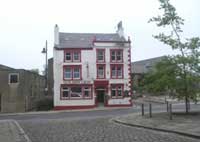
The Golden Lion, Moor Lane
The discussion was becoming animated, so Gordon went over to Michael. He didn't want an argument but he was against capital punishment. Wherever you went, people in Lancaster were taking sides for-and-against the popular doctor, eventually to be hanged at Strangeways, in Manchester.

Many remembered his kindness. Nothing too much trouble for his patients, in a mainly low-paid, working-class area. His fees were modest and he refused any payment from destitute sick people. It was a real tragedy all round.

"But he shouldn't have harmed the girl!" said the fat woman. And for many, that settled the matter: he deserved to hang.